Saunderstown resident helps drive History Channel's 'The Tesla Files'
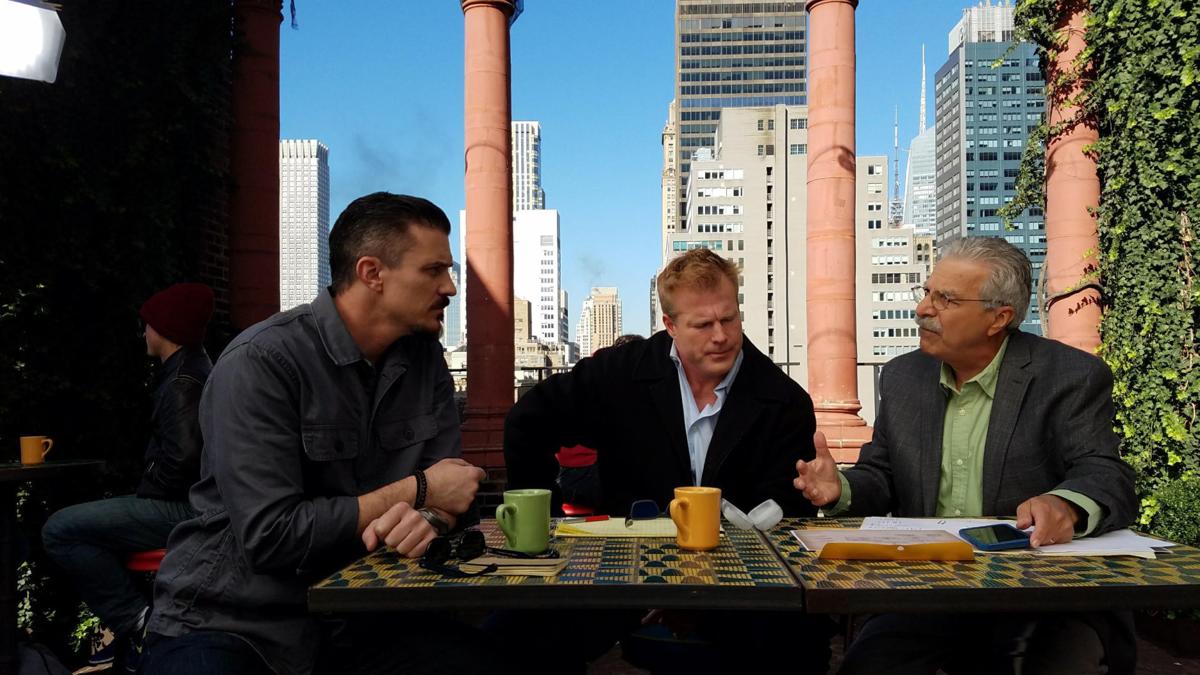
From left, John Stapleton, Travis Taylor and Marc Seifer make up the team of researchers for The History Channel show “The Tesla Files,” which aired its season finale June 1.
Inventor. Visionary. Superstar. Genius. Madman. We owe him, more than Thomas Edison, for our modern electronic lives, yet few would have recognized his name until just a few years ago.
In the late 19th and early 20th centuries, Nikola Tesla invented alternating current, developed radio and cell phone technology, conceived of wireless electricity, remote control and electric cars, designed a helicopter that turns into an airplane and devised a mega-weapon more deadly than the atomic bomb. His life story – and even more, the events surrounding his death – read like a true crime novel.
Marc Seifer, a Saunderstown resident with a range of professional experience, is convinced that not only was Tesla’s name scrubbed from history due to jealous rivals committed to preserving the status quo, but that the United States government cannibalized Tesla’s inventions for military use.
Seifer, who wrote the Tesla biography “Wizard: The Life and Times of Nikola Tesla” in 1996, is a driving force behind The History Channel series “The Tesla Files.” The series follows Seifer, Jason Stapleton and Travis Taylor as they reproduce Tesla’s experiments and search for the brilliant inventor’s missing documents.
After Seifer appeared in two episodes of The History Channel show “Ancient Aliens,” producer Kevin Burns approached him with the idea for a series devoted solely to Tesla. “He said, ‘I want it to be like ‘Mission: Impossible,’ and I want you to be Peter Graves,’” Seifer recalled.
Tesla, described by Seifer as “a very complicated personality,” ran in elite circles in the 1890s. The man who teamed with Westinghouse to light the 1893 Chicago World’s Fair “was a star among stars,” Seifer said.
“Before Tesla, in the 1880s, the only way you could light your house was by multiple power stations, because you could only send electricity about a mile and power dropped off with distance,” Seifer said. “And you could only power homes. Tesla comes along, and with one power [source] at Niagara Falls you can light up the entire Northeast. It’s clean energy. You can run appliances, you can run factories.”
He added, “It’s like comparing a horse and buggy to a spaceship.”
The first episode of “The Tesla Files” recalled Seifer’s efforts to track down papers declassified by the CIA and FBI in 2017 under the Freedom of Information Act, which led him to discover a document called the Trump Report. Tasked by the National Defense Research Committee with collating Tesla’s possessions after the inventor’s death at the New Yorker Hotel in 1943, electrical engineer and physicist John G. Trump – uncle of President Donald Trump – wrote that 20 trunks were found among Tesla’s belongings. But Tesla himself stated before his death that there were 80 such trunks.
What became of the other 60? And why did the 20 listed in the Trump Report take 10 years to be released to Tesla’s nephew in Belgrade?
Seifer believes those 60 trunks were confiscated by the U.S. military in its scramble to beat the Nazis in the development of a mega-weapon. The U.S. Navy’s electromagnetic railgun bears a striking visual and technological similarity to Tesla’s particle beam Transforce, or “Death Ray.” And he said Tesla’s “flipper plane,” patented in 1921, seems to be the inspiration for the Osprey aircraft.
Most of Tesla’s inventions hit closer to home. He also invented the induction motor, the electric transformer and fluorescent lighting, all of which we take for granted in our daily lives, to this day. Yet the names associated with electricity are Edison, General Electric and Westinghouse.
Why? According to Seifer, it was professional jealousy and Tesla’s poor business decisions that doomed him to obscurity. His name was “purposely kept out of textbooks because of legal and copyright issues.”
But Tesla unwittingly contributed to his own demise through his lack of business savvy, on display when he sold his patent for alternating current to Westinghouse in 1888. “We all grew up knowing the name Westinghouse,” Seifer said, but not the name “Tesla.”
Even though Tesla ran in the most elite circles in the late 19th century, he died alone and impoverished, his reputation in ruins as a pseudo-science crank.
Saunderstown resident helps drive History Channel's 'The Tesla Files'
![Saunderstown resident helps drive History Channel's 'The Tesla Files']() Reviewed by Nikolaloc
on
June 10, 2018
Rating:
Reviewed by Nikolaloc
on
June 10, 2018
Rating:


No comments: